

Overview
Automations connect your CRM to Apten. When something happens in your CRM — a record is created, or a field changes — an automation can respond automatically: create a lead in Apten, send a message, switch a lead’s customer profile, pause outreach, and more. Common use cases include:- A new lead lands in Salesforce → create the lead in Apten and start outreach
- An opportunity’s stage changes to Closed Lost → switch the lead to a re-engagement profile
- A contact is marked do-not-call in your CRM → add the number to your Do Not Contact list and turn the lead off
- An appointment is booked → send the lead a confirmation text with details pulled from the CRM record
- A Trigger — the CRM event that starts a run. Apten polls your connected CRM on a schedule you control and fires the automation for each matching record. See Triggers.
- Steps — an ordered list of things to do, built visually on a canvas. Steps can act in Apten (Actions), look up records in your CRM, or control the flow with Control steps.
Key Concepts
Prerequisites
- Admin access. Only organization admins can see and manage Automations. Other roles do not see the page.
- A connected CRM. Triggers and CRM actions require a connected Salesforce, Salesforce Sandbox, or Microsoft Dynamics integration. Connect one on the Integrations page first — see Salesforce or Microsoft Dynamics.
Navigating Automations
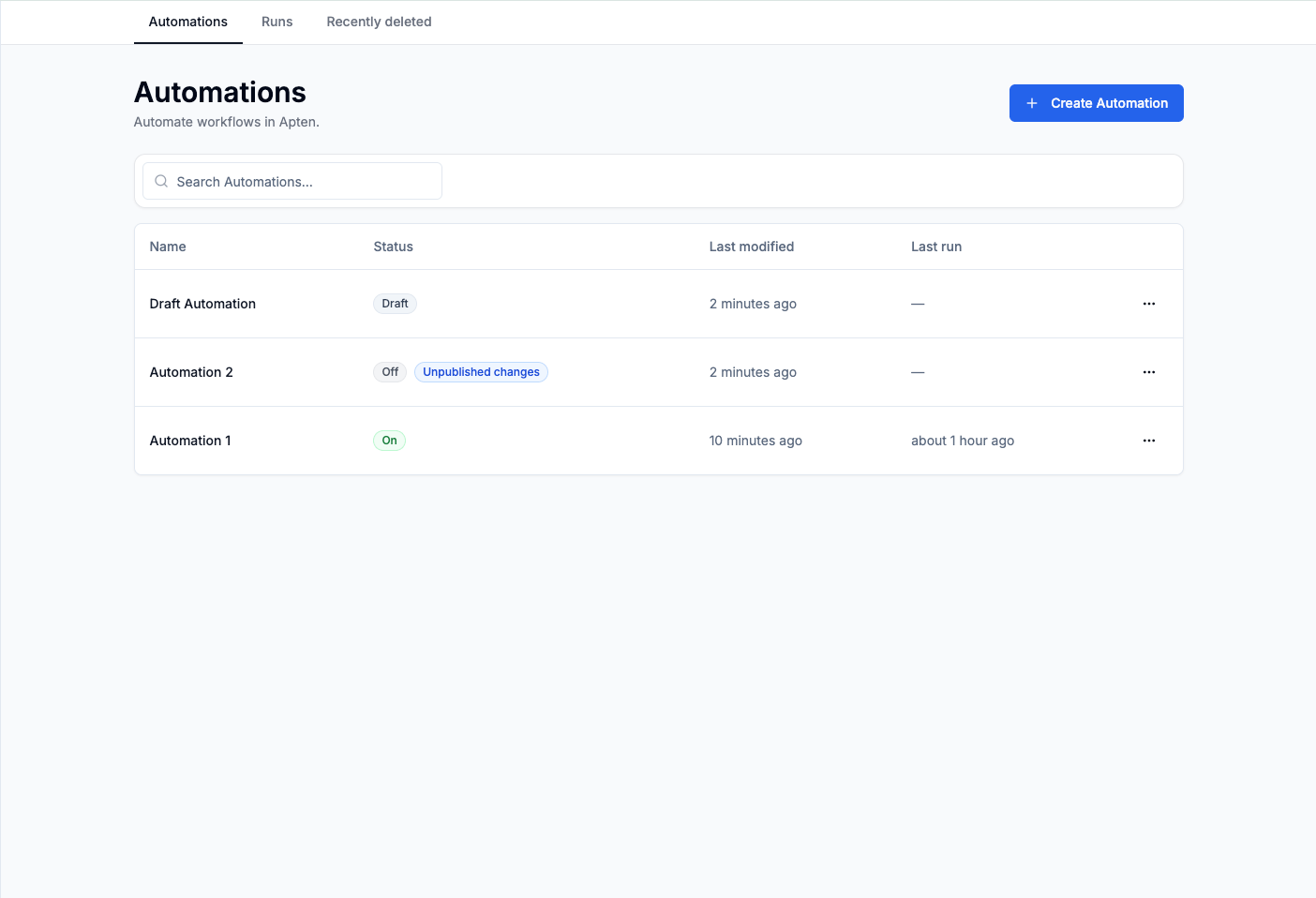
Open Automations in the sidebar. The page has three tabs:- Automations — every automation in your organization, with its status (Draft, Off, Activating…, or On), last-modified time, and last run. Click Create Automation to start a new one.
- Runs — the execution history across all automations, filterable by automation, status, and time range. See Runs & Troubleshooting.
- Recently deleted — deleted automations stay restorable here for 30 days.
Learn More
Building an Automation
Create, publish, and manage an automation end to end.
Triggers
New record and Field updated triggers, conditions, and polling.
Actions
Everything an automation can do in Apten and in your CRM.
Control Steps
Add conditions, pause a run, or split an automation into multiple paths.
Runs & Troubleshooting
Inspect run history and resolve failed steps.